Chocolate and alcohol are classic Lenten no-nos. But for some reason, this year I’m setting myself a new challenge
It’s that time of year again when the frying pan, milk and box of eggs come out for their big evening of pancake-making and I still have no idea what to give up for Lent.
Chocolate, like when I was a teenager? Please no. Alcohol? Also please no. What would be a meaningful sacrifice in this time of environmental crisis?
One idea reluctantly crawls to mind – how about I give up buying fresh food that has flown half way round the world just to sit on my plate for a few minutes? The Times on Saturday reported that Britons chomped through 2,920 tonnes of fresh strawberries, reaspberries and blueberries each week in December, and that these berries had been flown from as far a-field as Peru, Chile, Morocco and South Africa. Aviation is believed to account for 4 per cent of global warming, and President Trump is pulling the US ever further away from its commitments to reducing their carbon emissions. So my Lenten inner pilgrimage could have a whiff of protest to it.
What would that mean for my weekly shop? I can live without grapes and avocados, but I would miss the delicious mangoes that are marked as coming from Peru. I’ve been buying them because I’ve wanted to introduce our young son to the sticky joy of mango-slurping – as well as the Sensible Lesson of delaying gratification (because obviously everything sold as “ripe and ready” takes another week to ripen). Mangoes also remind me of my sunny pre-university months in West Africa, when I used my fresh A-level French to chat and make friends across a cultural divide, realising you could do so without having got the hang of the past subjunctive.
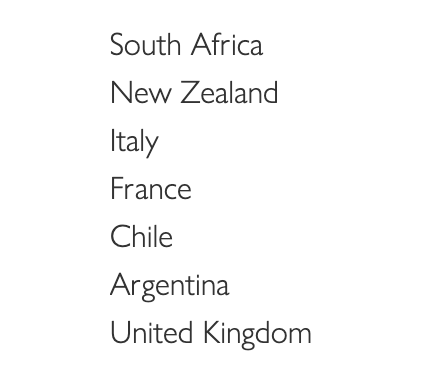
Back to Lent 2026. What else would I have to renounce? A quick look at a supermarket website should help. Ah no. There’s a vagueness when it comes to showing an item’s provenance and carbon footprint. For example, the apples we usually buy apparently come from any one of seven countries, only one is the UK and four are not very near at all:
So that’s clear then.
And the frozen blueberries that hold the promise of anti-ageing through their magical anti-oxidants are:
Packed in: United Kingdom
Phew – that’s great! Though they may have been rocketed in from Mars.
Will I end up eating like a medieval peasant? Will I age 10 years in six weeks? Will I have to choose between endless celery and 1980s no-fly, high-carb biscuits, and manage to put on weight during the traditional season of fasting? Do check back over the next few weeks as I try to investigate where on earth my food comes from and try to make sure my shopping habits aren’t doing rather more harm than good.
My extended family are meeting up in central Italy this summer. “Aha,” I thought, after reading one too many reports about the contribution of air travel to an environmental apocalypse, “let’s see if we can avoid flying. It might be a challenge with a small child, but what a great way to see Europe.” Surely it couldn’t be that hard? Could it?
Perhaps it has left the sidings and is chuntering towards us, but there is little sign of it yet. I am not a train nerd, but I am trying to avoid flying after reading one too many reports about the contribution of air travel to an environmental apocalypse.
My extended family are meeting up in central Italy this summer. “Aha,” I thought, “let’s see if we can avoid flying. It might be a challenge with a small child, but what a great way to see Europe,” and, I modestly said to myself, “And what an example we’ll set!”
In April I started with the ever-mysterious-sounding Seat61.com, but the routes highlighted were already selling for 15 times the €29 the site publicised. And the timings would have sliced through our little one’s daily routine, with the risk of causing pain to all of us.
I searched online for “no-fly travel” and found carefully curated tours of European idylls, accommodation included, but the photos were of wine glasses and sunsets, not swings and miniature trains.
I contacted a no-fly travel agent (there is such a thing), and spoke to the helpful Catherine Livesley, founder and director of the No-Fly Travel Club. For her to get us off the starting block, she required a one-year membership fee of £79 for an individual or £149 for a family which “includes up to 2 hours of support on the itineraries of your choice”. If we wanted her to book the tickets, that would cost extra.
This came as a shock after the ease of airline and domestic rail websites. But we were dealing with a business model that required work by a human rather than a search engine, and paid up. And it would be worth it – the aviation industry is responsible foraround 5 per cent of global warming, after all. And what an achievement if we could steam in to our holiday destination flight-free and brimming with tales of rewarding French stopovers!
Livesley quickly came back to us with two routes: one via Paris and Milan, back on a sleeper train from Nice, and a second via the ever-picturesque Swiss countryside. A sleeper train from Paris to Nice was already booked up, so we could only take it on the way home. She had thoughtfully broken the journey up into short-ish chunks to suit a young child, but these would require more hotel stays than if we were prepared to travel at any hour for any length of time.
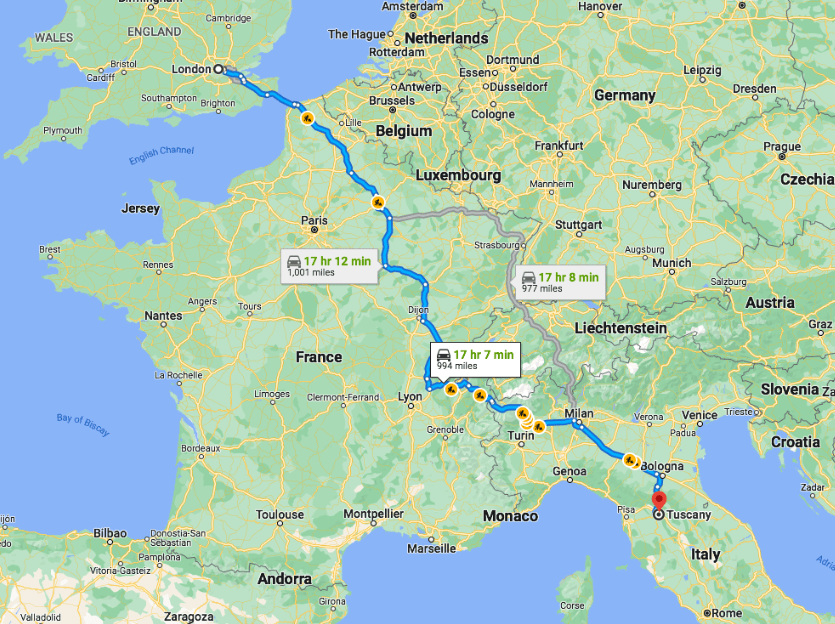
So we turned to the possibility of driving. Around 1,000 miles. We looked up tips for long distance driving with little ones and asked friends and family and the internet. We found exciting looking car-trains that had ceased running in the pandemic. We found a car train that for some reason offered to transport your car – a day or so after transporting the passengers. Then we found a Motorail service that reached Italy via Düsseldorf and would have transported our car as well. My husband called out as he scrolled through the timetable, “What does ‘Nicht verfügbar’ mean?” “Not available,” I replied with an increasing sense of resignation. There were technical problems on the line.
What if we did the drive by ourselves – surely it couldn’t be that hard? Au contraire: it would mean 19 hours’ (at least) driving on the unfamiliar right, with the risk of Little One getting fidgety or uttering the words, “I need a wee.” After we had begun our investigations and many evenings of discussions, we did a four-hour drive that was twice punctuated by those peace-shattering words. Both times, into action we flew, eyes peeled for the first sign of a service station, cartoonishly skidding in to race towards the facilities. The thought of executing this manoeuvre in a foreign country was not appealing.
Exhausted, we gave up. Reader, I apologise. We have booked air tickets. We are already paying for our weakness – a lack of weekend flights means that our already expensive tickets (more expensive than the train) will require several nights in a hotel. We had an option to carbon offset when we paid for them and I confess, I felt so sore to be paying more that I declined. (I’ve since made a donation to Friends of the Earth.) And yet any peace of mind about our journey was quickly swept away: the airline with which we booked has been cancelling flights.
So what to conclude? That for all our efforts we are – this year – contributing to the problem, and that our spending habits are no different from those of people who don’t care about the environment.
But also that the age of sleepers can’t come soon enough, and that car trains need to get up and running in sufficient volume; that governments may need to offer subsidies to help companies to scale up quickly so that even those with little concern for the environment are persuaded to avoid the airport. And that one way to reduce the carbon footprint of a holiday is to reduce the journey distance so that no-fly options are more feasible. In the mean time I wish Livesley and her ilk all the very best in weaning us off fast, child-friendly, easy-to-book, cheap-if-you-get-in-early, air travel.




 Commentrary