Visiting the Thames Barrier – the fiddliest daytrip in London

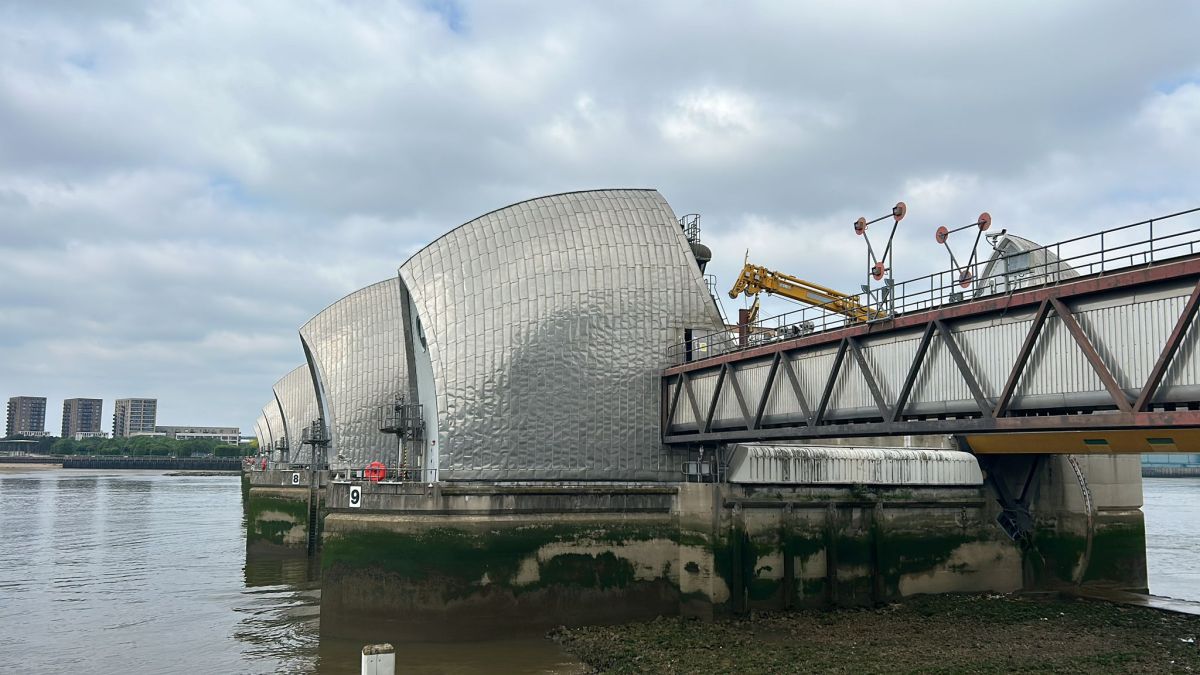
Its gleaming gates rise from the murky waters of the River Thames, and next week one of the country’s most under-sung feats of engineering will receive a visit from one of its highest-profile fans, the Emperor of Japan. But for most of us, planning a trip there is unbelievably fiddly.

Its gleaming gates rise from the murky waters of the River Thames like towers in a medieval castle wall, and next week one of the country’s most under-sung feats of engineering will receive a visit from one of its highest-profile fans.

The Emperor and Empress of Japan are making a private trip to the Thames Barrier before the engagements of their state visit next week. According to a touching article in The Times, Emperor Naruhito, when crown prince, devoted his postgraduate thesis to the river while at Oxford University in the 1980s.

And why shouldn’t they? To stand only metres from one of those giant rotating gates is awe-inspiring.

Except, unless you’re the Emperor of Japan and have imperial levels of administrative support (well, access to private boat trips and chauffeurs), the planning is unbelievably fiddly. In which case, read on.

For the steel-gated super-structure is surprisingly inaccessible.

I wanted to go because my five-year-old son is a budding engineer, into steam trains, diesels, modern trains, trams, buses and so on – and his grandparents were visiting us.

We needed a rainproof daytrip with multi-generational appeal, ie suitable for differing concentration spans and levels of mobility: one member of the group would want to run around constantly; another member would really not.

Even in five years, minus the lockdowns, we’ve ticked off many London attractions. So I cast my mind east and settled on the Thames Barrier. It’s one of the largest movable flood barriers in the world, according to the Environment Agency. And climate change is only making flood defences more topical. The other adults assured me they wouldn’t find it too nerdy.

That was the easy part. I imagined there would be a visitor centre just next to the barrier, from where a boat-trip would take visitors right up close. And a shop where you could buy postcards, cups of tea and books about Charles Draper, the engineer whose cooker’s gas taps gave him the inspiration for the rotating gates.

I adjusted my expectations when I found the barrier isn’t obvious from Google Maps. Que?

And if you want to pass between its gates by boat, the nearest pier is more than 1.5 miles away from the visitor centre car park.

Let’s start with the boat part.

You can take the Uber Clipper, which sails through the barrier, to Royal Woolwich Arsenal, disembark, have a quick coffee, and sail back the other way. There is a Thames Barrier Park on the other side of the river, so, on your return trip you’d need to hop back only one stop to Royal Wharf Pier, and then it’s a 15-20-minute walk away. Apparently there’s a great café there and some eye-impressive topiary, but we didn’t get there because the mobility issues put it out of our reach.

Yours to print out and draw on any missing elements

So accustomed am I to Google’s omniscience that I feel cheated when it turns out to be fallible and I should have consulted other, more British maps, such as Streetmap. So Royal Woolwich Arsenal, for example, is not just the old military buildings turned into tidy streets of private residences. A coffee shop is squeezed into one of two Grade 2-listed guardrooms, and the large Visitors’ Book Café, which has a full brunch menu, sits just the other side of a courtyard adorned with sculptures. Neither of these was obvious in advance. Had they been, we could have enjoyed some shakshuka or avocado on sourdough – tastier than a hasty sandwich on the boat.

Between the pale grey sky and murky grey river we sailed, and passing through such powerful gates was a privilege, if a fleeting one. The Thames Barrier Park being out of our reach, we opted to pad our day out with a quick stop at Greenwich, where the grounds of the Cutty Sark, with their benches and ice cream vans, are clearly more accustomed to welcoming visitors.

There is a visitor centre, next to the barrier, but it’s only open – and its phone is only picked up – for five hours on a Saturday. The boat stops a further 1.7 miles away, so if you want to visit, you’ll need a bus or a car. We returned to Royal Woolwich Arsenal, picked up our car and drove east down a busy A road through a markedly unloved part of town that has you questioning your eyes and your memory. Did I really see a sign? Did it really point down here?

Past the tired garages and up and down over untarred roads finally looms a tall, more promising sight. Sadly, having wanted to prioritise the boat trips, we arrived at the centre at 3.37pm to find it shut. Peering through a window of the centre I saw a notice that said the centre was only open by prior appointment.
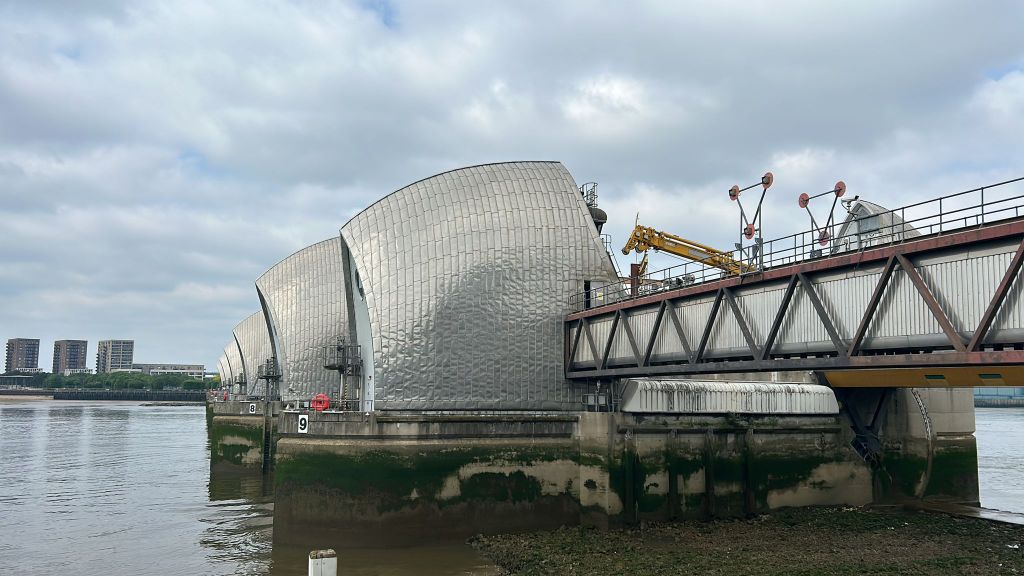
Finally paying homage, from the Thames Path beyond the shut Visitor Centre

Nonetheless, being close to the steel that was dazzling in the sunlight that had finally broken through, reinforcing the awe of seeing the structure from the water. The Thames Path bears an attractive mural of the course of the river from its source, though that its main audience when we visited – joggers – looked straight ahead. As for our five-year-old, awe-struck as he was, he also really enjoyed the little play park outside the visitor centre.

This last part will be less important to Their Majesties, but I hope their visit sparks a new interest in the structure that leads to it becoming easier to admire up close and be inspired by. There are some great things to see and do here, but it took perseverance to make them align. And the next time I go to an attraction and inwardly grumble that its marketing is too slick, I’ll remember what a hassle it is to visit something less joined up.

What happened when I tried to book a holiday without flying

My extended family are meeting up in central Italy this summer. “Aha,” I thought, after reading one too many reports about the contribution of air travel to an environmental apocalypse, “let’s see if we can avoid flying. It might be a challenge with a small child, but what a great way to see Europe.” Surely it couldn’t be that hard? Could it?

“Agatha Christie would be delighted,” declared Michael Binyon in The Times recently in an article about cross-Europe train travel, because, “The age of the sleeper is returning”.

Perhaps it has left the sidings and is chuntering towards us, but there is little sign of it yet. I am not a train nerd, but I am trying to avoid flying after reading one too many reports about the contribution of air travel to an environmental apocalypse.

My extended family are meeting up in central Italy this summer. “Aha,” I thought, “let’s see if we can avoid flying. It might be a challenge with a small child, but what a great way to see Europe,” and, I modestly said to myself, “And what an example we’ll set!”

In April I started with the ever-mysterious-sounding Seat61.com, but the routes highlighted were already selling for 15 times the €29 the site publicised. And the timings would have sliced through our little one’s daily routine, with the risk of causing pain to all of us.

I searched online for “no-fly travel” and found carefully curated tours of European idylls, accommodation included, but the photos were of wine glasses and sunsets, not swings and miniature trains.

I contacted a no-fly travel agent (there is such a thing), and spoke to the helpful Catherine Livesley, founder and director of the No-Fly Travel Club. For her to get us off the starting block, she required a one-year membership fee of £79 for an individual or £149 for a family which “includes up to 2 hours of support on the itineraries of your choice”. If we wanted her to book the tickets, that would cost extra.

This came as a shock after the ease of airline and domestic rail websites. But we were dealing with a business model that required work by a human rather than a search engine, and paid up. And it would be worth it – the aviation industry is responsible for around 5 per cent of global warming, after all. And what an achievement if we could steam in to our holiday destination flight-free and brimming with tales of rewarding French stopovers!

Livesley quickly came back to us with two routes: one via Paris and Milan, back on a sleeper train from Nice, and a second via the ever-picturesque Swiss countryside. A sleeper train from Paris to Nice was already booked up, so we could only take it on the way home. She had thoughtfully broken the journey up into short-ish chunks to suit a young child, but these would require more hotel stays than if we were prepared to travel at any hour for any length of time.

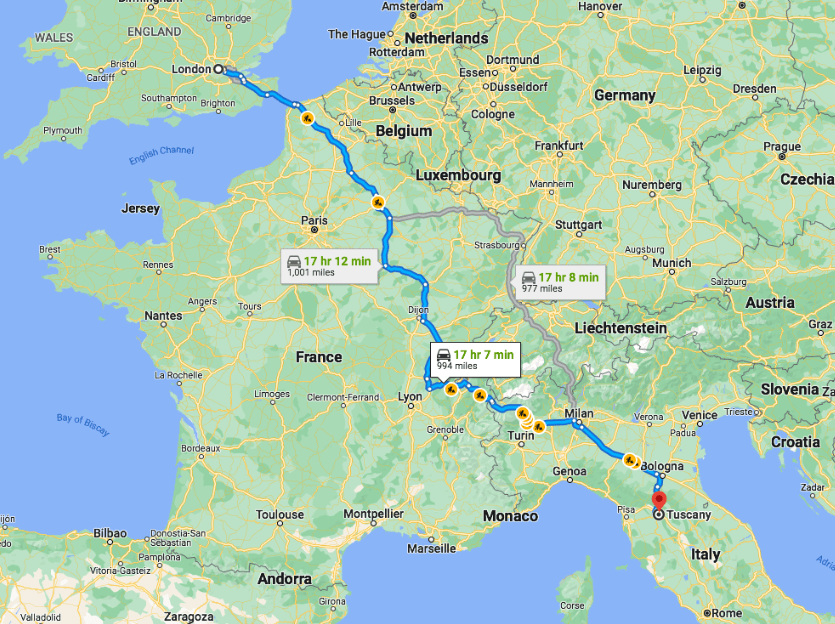
So we turned to the possibility of driving. Around 1,000 miles. We looked up tips for long distance driving with little ones and asked friends and family and the internet. We found exciting looking car-trains that had ceased running in the pandemic. We found a car train that for some reason offered to transport your car – a day or so after transporting the passengers. Then we found a Motorail service that reached Italy via Düsseldorf and would have transported our car as well. My husband called out as he scrolled through the timetable, “What does ‘Nicht verfügbar’ mean?” “Not available,” I replied with an increasing sense of resignation. There were technical problems on the line.

What if we did the drive by ourselves – surely it couldn’t be that hard? Au contraire: it would mean 19 hours’ (at least) driving on the unfamiliar right, with the risk of Little One getting fidgety or uttering the words, “I need a wee.” After we had begun our investigations and many evenings of discussions, we did a four-hour drive that was twice punctuated by those peace-shattering words. Both times, into action we flew, eyes peeled for the first sign of a service station, cartoonishly skidding in to race towards the facilities. The thought of executing this manoeuvre in a foreign country was not appealing.

Exhausted, we gave up. Reader, I apologise. We have booked air tickets. We are already paying for our weakness – a lack of weekend flights means that our already expensive tickets (more expensive than the train) will require several nights in a hotel. We had an option to carbon offset when we paid for them and I confess, I felt so sore to be paying more that I declined. (I’ve since made a donation to Friends of the Earth.) And yet any peace of mind about our journey was quickly swept away: the airline with which we booked has been cancelling flights.

So what to conclude? That for all our efforts we are – this year – contributing to the problem, and that our spending habits are no different from those of people who don’t care about the environment.

But also that the age of sleepers can’t come soon enough, and that car trains need to get up and running in sufficient volume; that governments may need to offer subsidies to help companies to scale up quickly so that even those with little concern for the environment are persuaded to avoid the airport. And that one way to reduce the carbon footprint of a holiday is to reduce the journey distance so that no-fly options are more feasible. In the mean time I wish Livesley and her ilk all the very best in weaning us off fast, child-friendly, easy-to-book, cheap-if-you-get-in-early, air travel.

Top image: via Queens University, Ontario