

Who wouldn’t want to go back just for one day? To 13 July 1985, when the nation’s coolest rock musicians came together and electrified the 72,000 people filling Wembley Stadium and millions more viewers at home, and galvanised the British public to give around £50m for victims of the Ethiopian famine.
There is a lot to celebrate in BBC2’s Live Aid at 40: When Rock ’n’ Roll Took on the World. The three-part series has pulled in an impressive run of interviewees that included organisers Bob Geldof and Bono, Sting, Midge Ure, Phil Collins; politicians George Bush, Condoleezza Rice and Tony Blair, the head of Ethiopia’s Relief and Rehabilitation Commission, Dawit Giorgis, former Nigerian President Olusegun Obansanjo – and Birhan Woldu, the woman who as a near-dying young girl had become the face of the Ethiopian famine at Live Aid.
The series transports you to a time when our tiny island was doing what it loves doing best: punching above its weight
The interviewees and footage provide a multi-dimensional look at the event and its second punch, 2005’s Live 8, from British, American and crucially, African, perspectives. (Slightly awkward triangle of locations, mind – it rings a bell of some sort.) They built a picture of how the concert helped to raise the profile of aid in public awareness and foreign policy and how it was followed by an understanding of the need to articulate and address the causes of poverty.
Accompanied by a zinging soundtrack, it transports you to a time when our tiny island was doing what it loves doing best: punching above its weight. Geldof’s Live Aid concert inspired a similar concert in Philadelphia and more around the world, and leading efforts that ultimately raised a total of £150m.
Somewhat alarmingly the series is categorised as “history”. Then again, it did make history: technologically, socially and politically
Somewhat alarmingly the series is categorised as “history”. Then again, it did make history: technologically, socially and politically. The British public, today worn down by “scandal-hit” this and “broken” that, can look back to when quality BBC journalism led to the creation of a charity song that raised £8 million and pressured the Government of Margaret Thatcher to allocate food aid to a forgotten corner of a then-Marxist African nation.
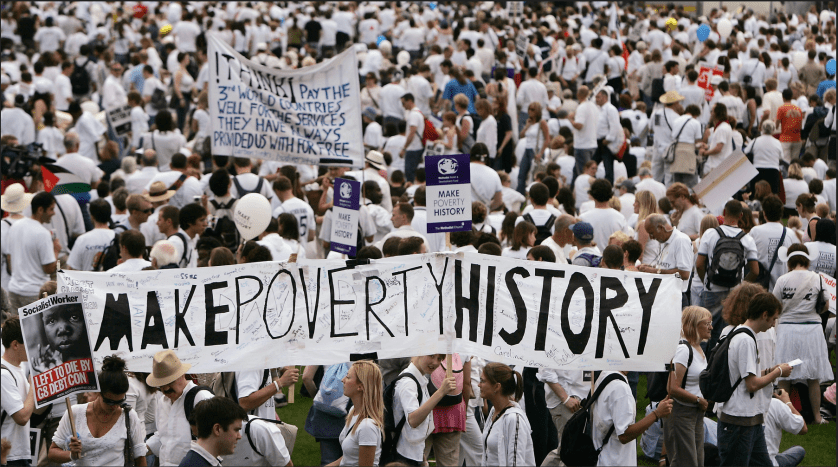
In 2005 Geldof issued a new call to action for Live 8, the campaign focused on Western-linked causes of extreme poverty and on the G8 summit that the UK would chair that July. A-list musicians prepared for concerts in Wembley, Philadelphia and in the other G8 nations and an estimated 30 million viewers worldwide tuned in to watch. (We learnt that South Africa’s event, at which Nelson Mandela spoke, was an afterthought, to the organisers’ embarrassment.) Meanwhile public opinion was galvanised through the affiliated Make Poverty History campaign for which NGOs and their supporters marched for clear asks on trade, aid and debt. Some 225,000 people took part in the march in Edinburgh. G8 leaders – including Vladimir Putin – pledged to increase aid, cancel some debt and reduce trade barriers. The documentary shows Tony Blair reflecting that that was the last time that world leaders acted together for the common good.
What would a third event or campaign focus on now? What cause would it champion and who would it lobby?
The question it left me with was, what would a third event or campaign focus on now? Surely it would involve more artists of colour because there are more top-selling British artists of colour, and there would be little tolerance for a mostly white line-up. But what cause would it champion and who would it lobby?
After all, as the world begins to re-arm, areas for global co-operation are shrinking and, as aid budgets get funnelled to defence, ploughshares are being turned into swords.

A big cause of suffering making headlines is linked to so-called “natural disasters” such as flooding and droughts. As I write, the death toll from the Texas flash floods stands at at least 109. We know such disasters are becoming more likely due to climate change. (Indeed, to the extent that they are caused by climate change, how much longer can we call them natural?) We can ask our leaders to re-commit to the Paris Agreement or hasten their nation’s path to Net Zero, share-holders can make their environemntal concerns known to companies, but a lot of the commitment comes back to individuals. Can anyone picture a stadium of 70,000 concert-goers waving their hands to show they commit to slashing their carbon footprint and boarding a plane only in emergencies?
Charities are urging the public to meet with their MPs today at an event called the Mass Lobby to assure their elected leaders that they still really want politicians to make choices to reduce the impact of climate change. Nearly 5,000 people have signed up to take part. I hope politicians will listen, with or without celebrity big guns. A greater push is needed to get from 5,000 to 70,000 or 225,000 – or indeed the millions needed to demonstrate widespread consensus and move the global dial.
Unlike a famine, which can be ended if the international community has the will, preventing the climate from breaking down is an ongoing commitment that costs more than the price of a record or a concert ticket or a one-off donation. Are we up to the challenge?
Top: The official Live Aid poster. Eil.com, fair use, via wikipedia
 Commentrary