
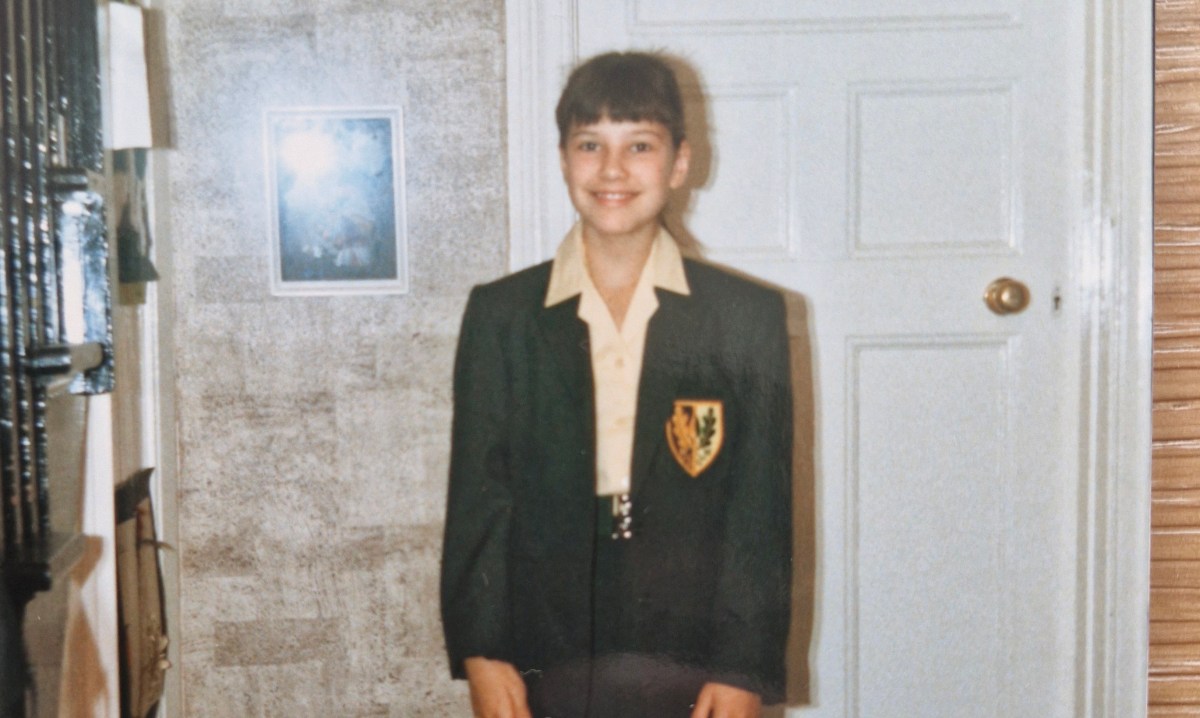
My old secondary school, Newstead Wood School, has just been named The Sunday Times’ State Secondary School of the Year in London 2025. Brava! The girls in bottle green are still swotting away and climbing to the top of the league tables. And brava to the Year 6s who have just been told they have a place there. While I am proud of the school’s academic achievements, two return trips I made there last year – after 30 years – have got me thinking about what I would want to say to those hard-working girls.
According to The Sunday Times, pupils at my old school take part in Model UN debates and there is finally a football club. When one of my peers asked if we could learn football or rugby, she was told it might have damaged the development of our breasts – quelle horreur. Now you will get the chance to participate in the nation’s favourite sport, for which we – all right, mainly just men – divide themselves into tribes and war-paint their faces. I mean, no one ever did that for a netball match.
And I hope you also pick up the post-match bants. This will come in handy when you have to encounter actual men in the workplace. Unencumbered by niceties, manspeak can seem blunt, even presumptuous – but once you tell yourself you were not born obliged to end every spoken request with “if that’s all right?” and every written request with a smiley emoji, you realise it is actually rather efficient.
Surely we educate girls for the workplace, not the netball court.
Talking of netball, what is the point? Who knew fitness can be satisfying and fulfilling? Not us, from the hours we spent watching the tall, sporty kids pass each other the ball while the rest of us loitered, sans endorphins, in our flimsy skirts, feeling redundant. We were closer to hypothermia than breaking into a sweat, yet we were still haunted by the fear of the showers being switched on – and the dreaded communal run-through. No, cycling and running are my cup of tea, and a shower in a locked bathroom.
If netball and hockey were supposed to teach us how to be assertive, constructive members of a team (and maybe football and rugby work for boys), more accessible activities must exist for girls – ones that might actually arise in the workplace and that don’t depend on our oh-so-embarrassing teenage bodies. After all, surely we educate girls for the workplace, not the netball court.
As Margaret Thatcher and Amy Winehouse would say: “No, no, no.”
But here’s the thing, and a big secret you’re not told when the carrot of an A* is being held out just within reach if you only swot that bit harder: there is a social wealth associated with being a man that has been quietly accrued over centuries of unbelievably sexist laws and ways of thinking. While men were favoured because they would legitimately carry on the family line and name, if a woman was made pregnant while unmarried, no one thanked her for the fact the child would continue the name. (One could say “she got pregnant” like she “got a new pair of shoes”, but pregnancies don’t just happen, do they.) And even though we women are far less likely to start wars, invade countries, commit murders and rob banks, some of us are still rewarded with, for example, unconscious bias in families towards boys, and a disappointingly long shadow caused by inheritance patterns that still favour men. As Margaret Thatcher and Amy Winehouse would say: “No, no, no.”
As hard workers and high achievers, you could find yourselves rising to places where privilege, confidence and connections conspire to overshadow Britain’s apparent meritocracy. A grammar girl with straight As may find herself being out-praised by a privileged toff with no chin. Our dear alma mater didn’t spell out this ugly truth, but it’s best you start to come to terms with it now. Just know that your struggle is not yours alone, and is definitely not your fault.
Here’s another tip: top grades open university doors and can boost confidence, but beyond that, there their magical power ends. You may endure a hideous break-up from a spotty oik who never deserved you and wonder, “How did I end up here? I was a straight As girl!” That’s because letters aren’t life skills, darling. Especially if this scenario should befall you once you’re in work, pick yourself up quickly and press on, or the less gifted chap in the office may take the chance to impress your boss while you’re sobbing in the Ladies’.
Perfectionism doesn’t make you perfect, it makes you brittle.
And please, please, don’t become perfectionist. It’s such a temptation for high-flyers to become addicted to top grades – and then have no clue how to handle getting something wrong. Mistakes must be learning experiences, not shaming experiences (even if your boss thinks otherwise). Perfectionism doesn’t make you perfect, it makes you brittle.
I offer a sprinkling of anecdotes from a time when social media had not yet begun to shred teenage girls’ self-esteem and a dose of second-wave feminism went a long way.
At our reunion last year, after a long line of male senior staff had given talks about this or that, the now octogenarian headmistress who had retired during my sixth form skipped up to the podium looking scarcely a week older, and certainly happy to be back. She shared anecdotes, including about when a cancelled school trip resulted in disappointed girls deciding to join her and her late husband on their holiday. She also recalled an occasion a pupil asked to borrow her academic gown for an assembly, and proceeded to lead the assembly impersonating her. Irreverence, girls; vital.
Let’s hear it for irreverence. In my first year at Newstead, a year 11 class (Year 11 – looking so grown up – they even had breasts!) ran a fundraising week, and included a competition for which you had to guess the combined weight of the six male teachers. Without a second thought, we paid our 20p to objectify the men who bravely walked our oestrogen-filled corridors.
One of these short-strawed men had been given a lively Year 10 class for the year, members of which – in distinctly dubious taste – had pinned a Tampax advert to the class noticeboard and scrawled their teacher’s name and that of one of the other male teachers above the two sanitary products pictured.
This was a place that evoked the role-reversing Lord of Misrule (or should that be, the Ladies of Misrule?). During one much-anticipated Sixth Form Revue, a parody assembly was staged in which the wigged girl lampooning the deputy head dropped to her most serious voice to inform the girls that a flasher had been seen in the woods behind the school (not an uncommon occurrence). In their parody the girls all jumped to their feet in excitement and ran off screaming, “Where?”
The lesson from this is that humour punctures fear, and men can be gently mocked. Very handy, in all sorts of situations. When I was in my late thirties, a scaffolder cat-called me. (Me – cat-called in my late thirties!) I looked at where he was standing and enjoyed shouting up, “That’s my house!” At which pointed his colleagues laughed at him and he went quiet. This is all so far away from the nasty intimidation of women that MeToo highlighted.
So, obviously, keep trying to beat the boys in exams – that’s always fun, and becomes more so if later in life you manage to outpace someone who has been more highly privileged by life. But don’t beat yourself up if you don’t manage to; there will be other outlets for your talents. Learn manspeak and how to use it to maximum effect; give up those anxious emojis for Lent/for Ramadan/for ever; do not lower your dating standards, even if you’re feeling a bit lonely; campaign for the abolition of netball and run-throughs; ignore Instagram, and embrace irreverence.
There’s your checklist, girls!




 Commentrary