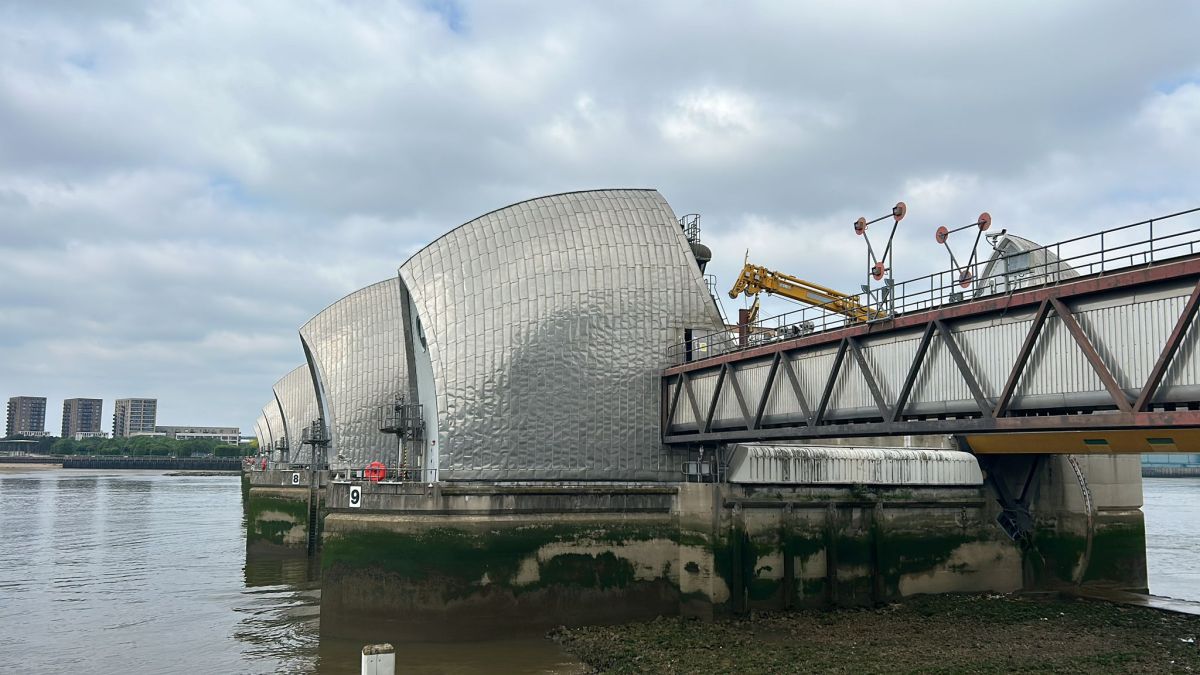
Visiting the Thames Barrier – the fiddliest daytrip in London

Its gleaming gates rise from the murky waters of the River Thames, and next week one of the country’s most under-sung feats of engineering will receive a visit from one of its highest-profile fans, the Emperor of Japan. But for most of us, planning a trip there is unbelievably fiddly.

Its gleaming gates rise from the murky waters of the River Thames like towers in a medieval castle wall, and next week one of the country’s most under-sung feats of engineering will receive a visit from one of its highest-profile fans.

The Emperor and Empress of Japan are making a private trip to the Thames Barrier before the engagements of their state visit next week. According to a touching article in The Times, Emperor Naruhito, when crown prince, devoted his postgraduate thesis to the river while at Oxford University in the 1980s.

And why shouldn’t they? To stand only metres from one of those giant rotating gates is awe-inspiring.

Except, unless you’re the Emperor of Japan and have imperial levels of administrative support (well, access to private boat trips and chauffeurs), the planning is unbelievably fiddly. In which case, read on.

For the steel-gated super-structure is surprisingly inaccessible.

I wanted to go because my five-year-old son is a budding engineer, into steam trains, diesels, modern trains, trams, buses and so on – and his grandparents were visiting us.

We needed a rainproof daytrip with multi-generational appeal, ie suitable for differing concentration spans and levels of mobility: one member of the group would want to run around constantly; another member would really not.

Even in five years, minus the lockdowns, we’ve ticked off many London attractions. So I cast my mind east and settled on the Thames Barrier. It’s one of the largest movable flood barriers in the world, according to the Environment Agency. And climate change is only making flood defences more topical. The other adults assured me they wouldn’t find it too nerdy.

That was the easy part. I imagined there would be a visitor centre just next to the barrier, from where a boat-trip would take visitors right up close. And a shop where you could buy postcards, cups of tea and books about Charles Draper, the engineer whose cooker’s gas taps gave him the inspiration for the rotating gates.

I adjusted my expectations when I found the barrier isn’t obvious from Google Maps. Que?

And if you want to pass between its gates by boat, the nearest pier is more than 1.5 miles away from the visitor centre car park.

Let’s start with the boat part.

You can take the Uber Clipper, which sails through the barrier, to Royal Woolwich Arsenal, disembark, have a quick coffee, and sail back the other way. There is a Thames Barrier Park on the other side of the river, so, on your return trip you’d need to hop back only one stop to Royal Wharf Pier, and then it’s a 15-20-minute walk away. Apparently there’s a great café there and some eye-impressive topiary, but we didn’t get there because the mobility issues put it out of our reach.

Yours to print out and draw on any missing elements

So accustomed am I to Google’s omniscience that I feel cheated when it turns out to be fallible and I should have consulted other, more British maps, such as Streetmap. So Royal Woolwich Arsenal, for example, is not just the old military buildings turned into tidy streets of private residences. A coffee shop is squeezed into one of two Grade 2-listed guardrooms, and the large Visitors’ Book Café, which has a full brunch menu, sits just the other side of a courtyard adorned with sculptures. Neither of these was obvious in advance. Had they been, we could have enjoyed some shakshuka or avocado on sourdough – tastier than a hasty sandwich on the boat.

Between the pale grey sky and murky grey river we sailed, and passing through such powerful gates was a privilege, if a fleeting one. The Thames Barrier Park being out of our reach, we opted to pad our day out with a quick stop at Greenwich, where the grounds of the Cutty Sark, with their benches and ice cream vans, are clearly more accustomed to welcoming visitors.

There is a visitor centre, next to the barrier, but it’s only open – and its phone is only picked up – for five hours on a Saturday. The boat stops a further 1.7 miles away, so if you want to visit, you’ll need a bus or a car. We returned to Royal Woolwich Arsenal, picked up our car and drove east down a busy A road through a markedly unloved part of town that has you questioning your eyes and your memory. Did I really see a sign? Did it really point down here?

Past the tired garages and up and down over untarred roads finally looms a tall, more promising sight. Sadly, having wanted to prioritise the boat trips, we arrived at the centre at 3.37pm to find it shut. Peering through a window of the centre I saw a notice that said the centre was only open by prior appointment.
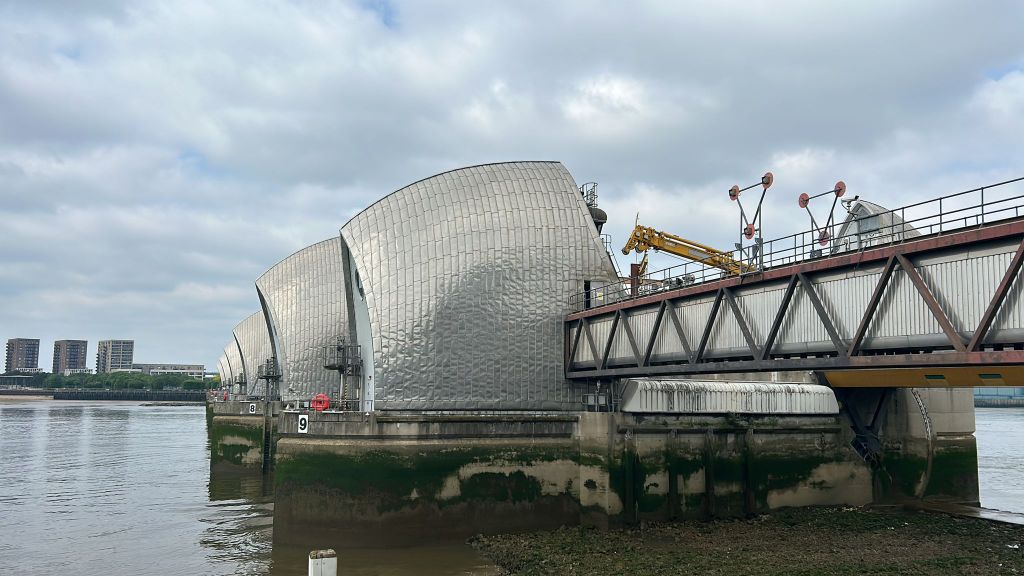
Finally paying homage, from the Thames Path beyond the shut Visitor Centre

Nonetheless, being close to the steel that was dazzling in the sunlight that had finally broken through, reinforcing the awe of seeing the structure from the water. The Thames Path bears an attractive mural of the course of the river from its source, though that its main audience when we visited – joggers – looked straight ahead. As for our five-year-old, awe-struck as he was, he also really enjoyed the little play park outside the visitor centre.

This last part will be less important to Their Majesties, but I hope their visit sparks a new interest in the structure that leads to it becoming easier to admire up close and be inspired by. There are some great things to see and do here, but it took perseverance to make them align. And the next time I go to an attraction and inwardly grumble that its marketing is too slick, I’ll remember what a hassle it is to visit something less joined up.

Re-examining the slave trade is good for Britain

This week the statue of Lord Nelson was taken down in a dignified ceremony to be taken to a museum. The monument to the naval leader who had defended slavery had been a symbol of pain and humiliation, and its removal was described by culture minister John King as “a step towards the healing of the nation”. 

Despite the efforts of Black Lives Matter protestors, the statue wasn’t atop Nelson’s Column in London; it had been standing in the Barbadian capital Bridgetown for more than two centuries. 

Throughout the Anglophone world, calls are growing for the re-examination of the slave era. In Britain there is more public interest in Britain’s involvement in the slave trade and the industries that relied on slave labour now than at any other time in recent decades. This is partly because staggeringly little is known about it among certain generations and partly because attitudes have shifted away from the assumption that the Empire was simply a force for good, towards wanting to hear the experiences of the black and brown people who now call Britain home.  

And as historian James Walvin said in Enslaved, the recent BBC Two series with Samuel L Jackson, the reason that the British public tolerated involvement in slavery persisted so long was: “out of sight, out of mind”. 

Yet the newly rediscovered interest in Britain’s deep involvement with slavery has the power to disgust and revolt as it did 200 years ago, when abolitionists were travelling the country revealing to incredulous audiences the British-made iron shackles and torture implements being used in and en route to the Caribbean.  

After the statue of benefactor Edward Colston was dragged through the streets of Bristol and tipped into the city’s harbour in June, journalists reported that his employer, the Royal African Company, branded the West Africans it sold as slaves – men, women and children – with the initials of their owners. This detail was, to many people, news.

Portraits of the Georgian aspiring middle classes depict respectability. The Vigor Family by Joseph Highmore, 1744, public domain, via Wikimedia Commons

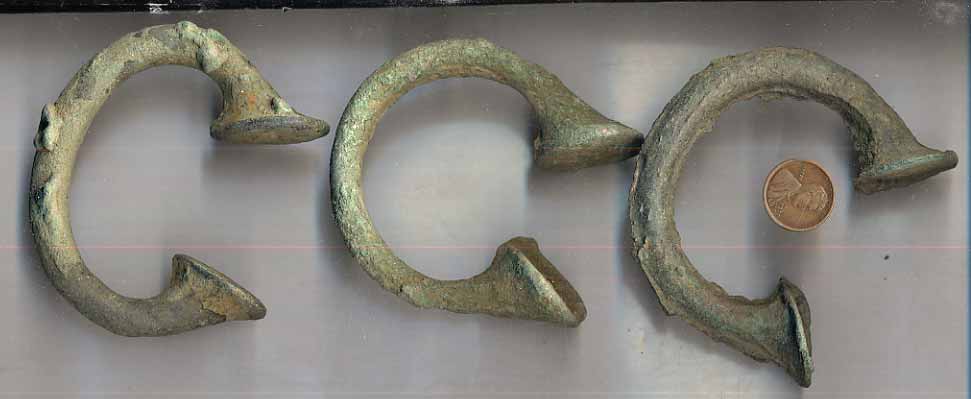
Just as Colston had a hidden side, so do many other figures and events we haven’t tended to associate with slavery. It was King Charles II who expanded British slavery into West Africa; it was the Industrial Revolution that enabled the mass production of restraints that were to be used on African slaves and the “manila” bracelets (often in factories in Birmingham) with which slaves could be bought. Our images of wigged noblemen dashing from stately homes to Georgian townhouses in pursuit of Jane Austen heroines all need serious updating. How did those noblemen make their money? What funded those mansions? The British economy was increasingly built around slavery, so even people not involved in human trade or forced labour may well have only been one step removed. 

Manilas such as these made in Birmingham were used as currency to buy slaves. Credit: Coincoin.com

The process of writing slavery back into our history is gaining pace. Last month the Financial Times told its readers about an “uncomfortable” walking tour of the City of London, a “financier of slave industries and a hotbed of abolitionism”. Institutions such as the Church of England and the Bank of England have apologised for their links to slavery. Other institutions’ links have been brought to light by recent academic work, while still others are hastily and nervously peering into their own archives.  

Of course, for this to become an academic exercise, or, worse still, just a reputation-saving one – would be a great shame. There is something deeply right, and therapeutic, about opening the door to reckoning when it comes knocking. Britain’s reputation here has not been good. Whenever someone (usually a black person) suggests reparations should be paid, some people (usually whites) roll their eyes and say history has moved on, and how would you know whom to pay and so on. 

Yet on the other side of the ocean, several institutions are just getting on with working it out. Let’s start with the Churches, whose historic involvement in slavery is particularly morally jarring. In the US, a number of Episcopalian (Anglican) and Presbyterian institutions have earmarked or collected funds for reparations. The diocese of Maryland has so far raised US$100,000 of a sought $1,000,000 and Long Island has pledged $500,000 to invest in education and training for local African-Americans. Georgetown (Catholic) University in Washington has undertaken a host of measures, partly under pressure from students, including raising tuition fees to support healthcare and education programmes in Maryland and Louisiana, which are home to many descendants of 272 slaves the university sold in 1838. 

These actions are striking because they reflect a heartfelt willingness to undo some of the long-lasting social and structural injustices erected by the slave era. What would the altruism seen at Georgetown achieve if it were replicated by banks, that have far more money than Churches, or governments? And what about the trade that continues today – how wealthy would the Caribbean be if every tonne of sugar or coffee it produces were traded at fair rates?

A fuller understanding of the black experience of slavery, along with the payment of reparations, could be an uncomfortable and costly process, but the result will be a more honest acknowledgement of possibly the most shameful chapter in Britain’s history, and an opportunity to affirm the rights of those who were so badly wronged.

Above: Nelson’s statue is driven away through the streets of Bridgetown. Via Sky News.